In short
Pesach, Passover, commemorates the Exodus from Egypt and the birth of the Jewish people as a nation. The Hebrew name for Egypt, Mitzrayim, shares a root with meitzarim, narrow places, so the festival is read on two levels at once: the historical liberation of a people and a personal exodus from constricted consciousness and limiting belief.
The big night is tonight!
I am so exciteddd.
Pesach is a big deal, and while there are many laws, rituals and intricacies, when we remember that every physical law has a spiritual dimension — something we can learn and grow from — everything becomes rich and meaningful.
In the same way that everything has a “physical” and a corresponding “spiritual dimension”, in Judaism things also have an “individual” and corresponding “collective dimension”. Which I attempted to share here with you:
INDIVIDUAL
Theme 1: FREEDOM
The Exodus story is about us as slaves leaving Egypt and becoming a
free
people in our land.
Everyone wants to be free, but what is freedom?
The best explanation I read was from Rav Kook, who says that
Pesach is the annual reawakening of
חרות אמיתית
— true freedom:
the freedom of the soul to live according to its inner truth and essence.
If Pesach is the annual reawakening of freedom…
What would it feel like for me to leave Egypt this year?
Theme 2: Mitzrayim = constricted consciousness / limiting beliefs
The Hebrew word for Egypt,
Mitzrayim
, shares a root with the word
meitzarim
, meaning “narrow places.” Egypt represents the constricted spaces of the soul — the internal and external limitations that confine us.
The exodus can be compared to a story of birth. Egypt becomes a kind of
womb
— dark, constricted, but necessary for growth.
The Exodus itself becomes the
birth canal
, and the splitting of the sea mirrors the
breaking of the waters
.
What follows is a moment of emergence:
Am Yisrael is born anew.
Pesach energy asks us :
What limiting beliefs do you need to release to birth a new you?
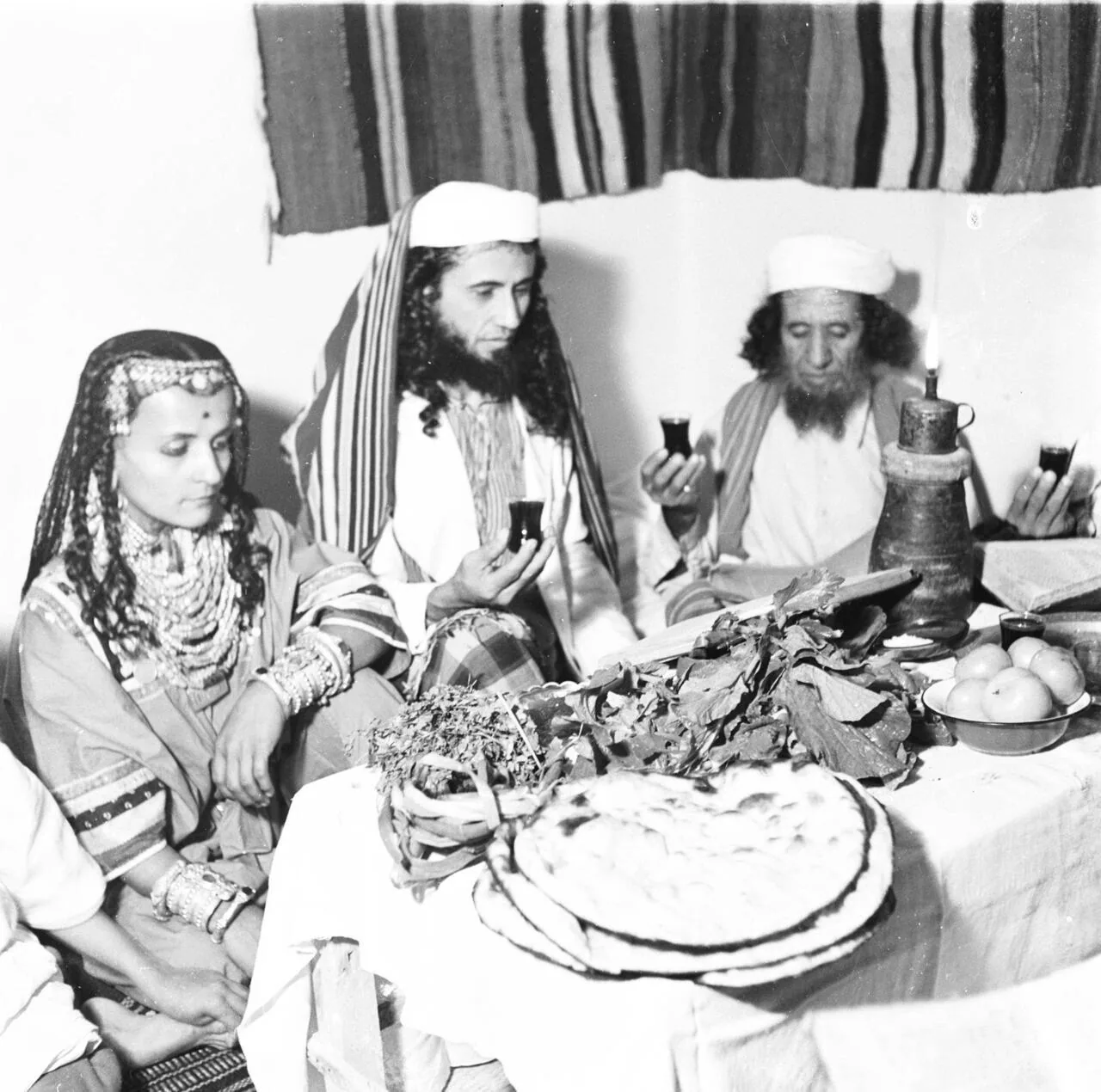
A yemenite seder.
COLLECTIVE
The OG Aliyah & the making of a people
Tonight, millions of Jews celebrate us becoming a nation in Israel 3,300 years ago.
The same land that today millions of people negate the Jewish people’s right to.
Forgetting that Jews are from Judea.
Forgetting that the religions of 4.5 billion Christians and Muslims are inspired by Judaism and the Torah.
And forgetting that every empire that ever tried to destroy us is not around today.
But the Jewish people are.
Because we never forgot who we are.
Because we sat around once a year and told the story of us becoming free.
Because we taught it to our children, we prayed for it, we died for it,
and now we are living it.
The world may have forgotten our connection to this land,
but Pesach reminds us that
the soul of the nation never detached from the land.
The connection between the Individual & Collective. Egypt & Israel.
On a personal level, exile is forgetting who you are.
But your truest self never disappeared — it was always there, waiting to be uncovered.
And the same is true collectively.
The Jewish people may have been exiled from the Land of Israel, but the land was always there.
The bond was never broken.
So just as the true self is never fully lost,
the Jewish people’s connection to the land was never fully severed.
We may have been in exile — but Israel was always there.
May this Pesach bring with it inner calm, peace inside and outside, may we honor and return, may our soldiers be safe, may this bloody war end and may Pesach be a portal for all the Good Hashem is bringing our way.
Love you!
Yarin
P.S.
Many of you don’t know but I am the founder of
WOOM.STUDIO
, a Design and Venture Studio.
Written by Yarin Weltsman (Queen Yarin)
About Yarin →Questions people ask
What does Mitzrayim mean?+
Mitzrayim is the Hebrew name for Egypt. It shares a root with meitzarim, meaning narrow or constricted places, which is why Egypt is read as a state of consciousness as well as a country.
What is Pesach actually celebrating?+
The Exodus from Egypt and the formation of the Jewish people as a free nation, retold each year at the seder.